Alliance News
South Africa service

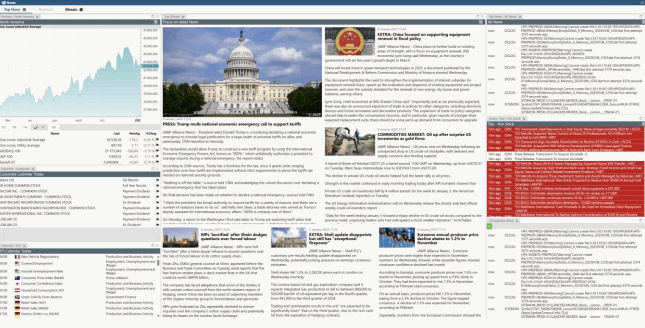
Complete real-time news for financial professionals in South Africa.
Alliance News South Africa Professional covers every actively traded company listed on the Johannesburg Stock Exchange, large and small. Our markets coverage tells you which stocks are moving, which are about to move, and why.
To complete the picture, the South Africa service includes top global economic, political and general news, reporting on influential global blue chips, and commentary on the foreign exchange, fixed income and commodities markets as well.
- SA Briefing – JSE opening call and overnight news – also as a daily email
- JSE market reports 3x daily – open, midday and close
- rand market report
- SA bond market report
- commodities market report
- SA economic indicators
- central bank decisions and government budget and policy
- sovereign credit ratings, IMF and other international organisations
- in-depth SARB preview
- Eskom and other SOCs
- SA Investor service also available for non-professional use

Key Features
Flash Headlines
Flash Headlines
*Accelerate Property Fund warns Oceana and KPMG likely to place pressure on earnings
Fri 27 Mar 2026 09:07 GMT
*Accelerate Property Fund transfers properties for combined ZAR796m
Fri 27 Mar 2026 09:06 GMT
*Accelerate Property Fund says disposals remain key lever in cutting debt
Fri 27 Mar 2026 09:06 GMT
*Accelerate Property Fund improves trading of Fourways Mall over FY26
Fri 27 Mar 2026 09:06 GMT
*Accelerate Property Fund continues to focus on restructure
Fri 27 Mar 2026 09:05 GMT
*ECB FEB CONSUMER 3-YR INFLA EXPECTATION 2.5% (2.6% JAN)
Fri 27 Mar 2026 09:00 GMT
*ECB FEB CONSUMER 1-YR INFLA EXPECTATION 2.5% (2.6% JAN)
Fri 27 Mar 2026 09:00 GMT
*China announces two reciprocal trade investigations against US
Fri 27 Mar 2026 08:32 GMT
*Visual International expects H1 EPS to drop more than 20% from 0.62c YoY
Fri 27 Mar 2026 08:06 GMT
*Greencoat Renewables buys back 552,858 shares at average EUR0.76 on Thursday
Fri 27 Mar 2026 07:41 GMT
*UK FEB RETAIL SALES EX-FUEL -0.4% M/M, +3.4% Y/Y
Fri 27 Mar 2026 07:00 GMT
*UK FEB RETAIL SALES INC FUEL -0.4% M/M, +2.5% Y/Y
Fri 27 Mar 2026 07:00 GMT
*GET READY: UK retail sales for Feb at 0700 GMT; consensus down 0.8% MoM, up 2.1% YoY
Fri 27 Mar 2026 06:45 GMT
*Anheuser-Busch InBev says Martin Barrington to leave after AGM on April 29
Fri 27 Mar 2026 05:58 GMT
*Anheuser-Busch InBev announces retirement of chair Martin Barrington
Fri 27 Mar 2026 05:57 GMT
SA Briefing
SA Briefing
02 Apr 2026 05:49 BST
SA BRIEFING: Top 40 futures lower after Trump nationwide address

(Alliance News) – Stocks are called down as investors look set to square positions ahead of the Easter break, with the Middle East conflict raging on.
Here is what you need to know before the Johannesburg market open on Thursday:
———-
MARKETS
———-
FTSE JSE Top 40: called down 1,751.36 points, 1.6%, at 107,056.00
———-
FTSE 100: called down 94.49 points, 0.9%, at 10,270.30
———-
Hang Seng: down 1.1% at 25,017.23
Tencent Holdings: down 1.7%
———-
S&P/ASX 200: down 1.1%
BHP Group: down 2.7%
———-
DJIA: closed up 224.23 points, 0.5%, at 46,565.74
S&P 500: closed up 46.80 points, 0.7%, to 6,575.32
Nasdaq Composite closed up 250.32 points, 1.2%, at 21,840.95
———-
US 10-year Treasury yield: 4.37% (4.31%)
US 30-year Treasury yield: 4.95% (4.90%)
———-
USD: ZAR16.98 (ZAR16.79)
bond R2035: 8.91% (8.90%)
gold: USD4,666.86 (USD4,744.90)
oil (Brent): USD107.66 a barrel (USD101.33)
———-
COMPANY CALENDAR
———-
No events are scheduled.
———-
ECONOMIC CALENDAR
———-
14:30 SAST US trade balance
14:30 SAST US initial jobless claims
16:30 SAST US EIA natural gas stocks
———-
SA NEWS
———-
BHP said it has completed its long-term silver streaming transaction with Wheaton Precious Metals International, a subsidiary of Vancouver, Canada-based Wheaton Precious Metals. The Melbourne, Australia-based diversified miner said the update follows an announcement made in February relating to its share of silver production at the Antamina mine in Peru. Under the silver agreement, BHP has received the USD4.3 billion upfront consideration from Wheaton and going forward BHP will be paid additional ongoing production transfer payments. In return, BHP will supply Wheaton with approximately 33.75% of silver produced at Antamina and once 100 million ounces has been delivered, the stream will be reduced to 22.5%.
———-
Trustco, Windhoek, Namibia-based financial services firm, agrees to implement a dual-audit structure, comprising separate but coordinated auditors and audit roles on company. Trustco has a primary listing on the Namibian Stock Exchange and a secondary listing on the Johannesburg Stoct Exchange. It says it is in the process of appointing Nexia SAB&T as group auditor for the financial years that ended August 31, 2024 and August 31, 2025. The company expects the JSE to list suspension once delayed results are published.
———-
GLOBAL NEWS
———-
US President Trump made his case for attacking Iran in his first nationwide address more than a month into the war, insisting the US was close to victory. In an evening speech from the White House, Trump broke little new ground on how the war would end and vowed two to three weeks further of “extremely hard” strikes against Iran. Trump said that the US was aiming to crush Iran’s military, end the clerical state’s support for regional armed groups and prevent it from obtaining a nuclear bomb – a prospect that the UN nuclear watchdog and many observers say was not imminent. “I’m pleased to say that these core strategic objectives are nearing completion,” Trump said. He again threatened that if Iran does not reach a negotiated settlement with him, the US would “hit each and every one of their electric generating plants.”
———-
Trump again berated European allies that have balked at supporting his war, on which he did not consult them in advance, as he noted that they are more dependent on Gulf oil. The countries that “receive oil through the Hormuz Strait must take care of that passage,” Trump said in his nationwide address, urging them to “build up some delayed courage.” He also said countries affected by the current fuel shortages should buy their oil from the US. “Buy oil from the US of America. We have plenty. We have so much,” Trump said in a national address in Washington, referring to countries affected by disrupted oil shipments through the Strait of Hormuz due to the Iran war.
———-
Iran said Washington’s demands were “maximalist and irrational” and denied any negotiations were under way on a ceasefire to end the war in the Middle East. “Messages have been received through intermediaries, including Pakistan, but there is no direct negotiation with the US,” said Iranian foreign ministry spokesman Esmaeil Baqaei, quoted by the ISNA news agency. He accused Washington of making “maximalist and irrational” demands and said Iran was ready for any attack, including an invasion by ground forces. Prior to this, Iran’s president asked the people of the US if the Middle East conflict was truly putting “America First”, accusing the US of war crimes. More than a month in, US President Trump claimed that Iranian President Masoud Pezeshkian was seeking a ceasefire, a claim Tehran has denied.
———-
The US lifted sanctions against Venezuela’s interim President Delcy Rodriguez, who took power after Washington ousted her predecessor Nicolas Maduro in a military operation in January. Rodriguez’s name was deleted from the “Specially Designated Nationals List,” according to a post on the US Treasury’s Office of Foreign Assets Control website. Rodriguez welcomed the decision, writing on X that it was part of the “normalization and strengthening” of bilateral relations.
———-
Ukrainian President Volodymyr Zelensky held talks with negotiators for President Trump on the peace process for his country. Zelensky wrote on X that the US side included Special Envoy Steve Witkoff, Trump’s son-in-law Jared Kushner and Senator Lindsey Graham. Nato Secretary General Mark Rutte also took part in the video call, he said. “Ukraine appreciates every effort America makes to forge a dignified peace,” Zelensky wrote in Kiev. “We agreed that our teams will remain in close contact over the coming days to strengthen the security guarantees document between Ukraine and the US. This is what can pave the way to a reliable end to the war.”
———-
UK Chancellor Rachel Reeves and supermarket bosses agreed to explore together how to ease the cost of living for consumers amid a warning that the Middle East conflict could see food inflation soar higher than 9% by the end of 2026. The Food and Drink Federation, which represents 12,000 food and drink manufacturers, hiked its inflation forecast for the year in light of the conflict. Reeves and Energy Secretary Ed Miliband hosted supermarket bosses, including from Tesco, Sainsbury’s and Aldi, for talks on Wednesday. “They agreed to work together to explore what more can be done to ease the cost of living for consumers and strengthen supply chains,” a government spokesperson said.
———-
Australian Prime Minister Anthony Albanese said the original aims of the war in Iran had been met and it was not clear what more remained to be achieved. Albanese called for de-escalation, noting that US-Israeli attacks had degraded Iran’s air force, navy and military industrial base. “Now those objectives have been realised it is not clear what more needs to be achieved or what the end point looks like,” he said during a speech in the capital Canberra. “What is clear is that the longer the war goes on the more significant the impact on the global economy will be.”
———-
Australia’s trade surplus surged ahead of expectations in February as exports rose and imports declined, official data showed. According to the Australian Bureau of Statistics, the seasonally adjusted balance on goods rose to a surplus of AUD5.69 billion in February, approximately USD3.94 billion, from AUD2.26 billion in January. The reading exceeded the AUD2.50 billion surplus that was expected based on the consensus forecast cited by FXStreet. Exports increased 4.9% to AUD45.65 billion from AUD43.52 billion while imports declined 3.2% to AUD39.96 billion from AUD41.27 billion.
———-
Australia will restrict betting advertisements in a bid to stem losses in one of the world’s biggest gambling nations, Prime Minister Albanese said. Sports betting advertisements are pervasive across the nation’s airwaves, enticing people to risk their money on everything from surfing to greyhound racing. Albanese said betting agencies will be restricted to three advertisements per hour between 6:00 am and 8:30 pm. Betting ads will be completely banned on live sports broadcast during those hours, and wagering firms will no longer be allowed to emblazon their brands across uniforms worn by professional teams. All gambling ads will be banned on radio during the hours of school pick-up and drop-off, Albanese said.
———-
SpaceX has filed confidentially for an initial public offering, Bloomberg reported, citing unnamed sources familiar with the matter. A SpaceX IPO would be the largest in history, with a valuation of over USD1.75 trillion, the sources said. SpaceX’s acquisition of Musk’s AI firm xAI in February had valued the enlarged company at USD1.25 trillion. Notably, the IPO is reported to have a large retail component, with SpaceX allocating as much as 30% of the offering to small investors. The company is considering a dual-class share structure in the listing, which would likely give insiders such as Musk extra voting power.
———-
By Artwell Dlamini, Alliance News senior reporter South Africa
Comments and questions to newsroom@alliancenews.com
Copyright 2026 Alliance News Ltd. All Rights Reserved.
Extra
Extra
26 Mar 2026 15:20 GMT
EXTRA: SARB scenarios predict inevitable rate hike amid Iran war
(Alliance News) – The South African Reserve Bank has signalled its readiness to raise interest rates if the conflict in the Middle East persists, pushing up energy prices and weakening the rand.
In a unanimous decision, the SARB’s Monetary Policy Committee maintained the repurchase rate at 6.75% for the second time in a row as expected. In January, the central bank also held rates steady. Late in November, it reduced the rate by 25 basis points, bringing cumulative rate cuts to 150 basis points since September 2024.
Following the “supply shock” from the Iran war, which started in February 28, the SARB on Thursday revised up its consumer price inflation forecast to around 4% in the second quarter of 2026, up from 3.3% forecast in January.
Before the US and Israel launched their coordinated airstrikes against Iran, headline inflation and inflation expectations ebbed, but the trends may reverse owing to the fallout from the war in the Gulf.
The consumer price index rose 3.0% year-on-year in February, moderating from 3.5% in January, data from Statistics South Africa showed on Wednesday last week, reaching the new 3% inflation target for the first time since its introduction in November last year. The target has a tolerance band of 1 percentage point either side.
Also, the annual core consumer price index, which excludes volatile items such as food and fuel, rose 3.0%, moderating from 3.4% in January, Stats SA reported on Wednesday last week.
Analysts, business people, and trade union officials lowered their average headline consumer inflation expectations for 2026 to 3.6% in the first quarter from 3.8% in the fourth quarter last year, survey results from the Bureau of Economic Research showed on Monday last week.
South African financial markets remains stable after the rate decision on Thursday, despite hawkish remarks.
The yield on the benchmark R2035 government bond was 8.96% on Thursday afternoon, where it stood at the time of the JSE close on Wednesday.
The dollar was buying ZAR17.03 on Thursday, up from ZAR16.88 at the time of the Johannesburg equities close on Wednesday.
The rate pause on Thursday potentially marked a shift that may culminate in monetary policy tightening.
As of November last year, the SARB has a new mandate to keep inflation at a target of 3%, with a tolerance band of 1 percentage point either side.
Signalling its vigilance against inflation, the SARB on Thursday looked at two alternatives.
The first scenario assumes that the conflict in the Middle East lasts another two months or so, with oil prices averaging nearly USD100 per barrel for this period and the rand about 5% weaker against the dollar.
The second, more extreme scenario has the war lasting over a year, with oil prices staying above USD100 per barrel and the rand 10% weaker.
In both scenarios, inflation is higher, exceeding 4% in the first version and 5% in the second. Both call for higher interest rates this year, with one hike in the first scenario and several more in the other, the SARB noted.
But inflation then slows as oil prices start easing and the policy response takes effect, the central bank predicted.
“In the first scenario we are back to target during 2027,” it said, adding: “In the second scenario this only happens in 2028.”
In the January meeting, the SARB had said that its worse case scenario – in which Brent crude hits USD75 a barrel and the dollar rises to ZAR18.50 – predicted that “even quite large shocks” would not push inflation outside the central bank’s tolerance range of 3% plus or minus one.
Other central banks have sounded hawkish of late.
Last week, the US Federal Reserve, the European Central Bank and the Bank of England acknowledged inflation pressures arising from soaring oil prices. The Bank of Japan, the Bank of Canada, and the Swiss National Bank also raised concerns around inflation last week. These central banks all held rates unchanged.
But the Reserve Bank of Australia on Tuesday last week hiked interest rates by 25 basis points, warning of inflation risk due to high fuel prices.
“The fact is, we are still only a few weeks into this crisis,” SARB Governor Lesetja Kganyago said in a statement on Thursday.
The coming months, Kganyago noted, will be crucial for assessing the longer-term inflation consequences of the Iran-US war, warning that the central bank sees inflation risks to the upside.
The governor reiterated that decisions will continue to be taken on a meeting-by-meeting basis, with careful attention to the outlook, data outcomes, and the balance of risks to the forecast.
Kganyago described the monetary policy stance as “moderately restrictive”, which helps bring inflation back to the 3% inflation target.
The governor said the standard response to a “supply shock” is to look through “first-round effects”, which are unavoidable and cannot be stopped by interest rate changes.
“At the same time, central banks should be alert to second-round effects, where an initial shock triggers broad price increases,” he said.
He acknowledged that it is always difficult to assess second-round effects in time.
It is unclear when the Iran war might end.
US President Donald Trump warned Iran Thursday to engage in talks to end the Middle East war “before it is too late”, after Tehran publicly spurned US overtures to resolve the nearly four-week conflict.
On Thursday, Pakistan confirmed that US-Iran indirect talks are taking place, AFP reports. Meanwhile, Israel launched strikes across Iran on Thursday.
In the light of the prevailing elevated global economic uncertainties, the SARB has again left interest rates unchanged for now, said Raymond Parsons, an economics professor at North-West University Business School. It is an inevitable further pause in the SARB’s recent interest rate-easing cycle.
Should the Gauteng petrol pump price rise by ZAR5 a litre, that would shift its year-on-year rate of change from deflation of 9,8% in February to a 12.5% increase in April, warned John Loos, an independent economist.
“This is a very significant shift, and could take the transport CPI back into positive territory, exerting additional upward pressure on overall CPI inflation,” Loos predicted.
The policy bias has shifted: risks are no longer skewed toward easing but toward a delay in rate cuts and, in more extreme scenarios, potential tightening, said Nolan Wapenaar, co-chief investment officer at Anchor Capital.
By Artwell Dlamini, Alliance News senior reporter South Africa
Comments and questions to newsroom@alliancenews.com
Copyright 2025 Alliance News Ltd. All Rights Reserved.
Broker Ratings
Broker Ratings
*DEUTSCHE BANK RESEARCH RAISES HAMMERSON PRICE TARGET TO 370 (320) PENCE – ‘HOLD’
Fri 20 Mar 2026 07:16 GMT
*CITIGROUP CUTS RICHEMONT PRICE TARGET TO 187 (193) SFR – ‘BUY’
Fri 20 Mar 2026 06:41 GMT
*GOLDMAN RAISES AB INBEV PRICE TARGET TO 82 (80) EUR – ‘BUY’
Fri 20 Mar 2026 06:05 GMT
*JPMORGAN CUTS ANGLO AMERICAN PRICE TARGET TO 2770 (2800) PENCE – ‘UNDERWEIGHT’
Fri 20 Mar 2026 04:51 GMT
*JPMORGAN CUTS QUILTER PRICE TARGET TO 212 (223) PENCE – ‘OVERWEIGHT’
Thu 19 Mar 2026 06:03 GMT
*GOLDMAN RAISES HAMMERSON PRICE TARGET TO 361 (327) PENCE – ‘NEUTRAL’
Tue 17 Mar 2026 05:31 GMT
Broker Notes
Broker Notes
24 Mar 2026 15:51 GMT
BROKER NOTES: BofA upgrades Richemont on above peer revenue growth
Compagnie Financiere Richemont SA – Bellevue, Geneva-based luxury goods manufacturer which owns Cartier and Montblanc – Bank of America raises to ‘buy’ (neutral) – price target CHF175 (CHF190)
Bank of America points out Richemont’s share price is down 20% in 2026 year-to-date and it now trades on 22 times 2027 earnings forecasts. But BofA notes the company continues to deliver revenue growth well above sector peers. “Considering the slower than expected recovery in soft luxury we think that the growth story of Richemont becomes more unique,” BofA adds. Whilst external factors are a headwind on 2026 and 2027 gross margins this now looks more reflected in consensus expectations, in BofA’s view. The broker adjusts forecasts to reflect Middle East disruption, and mark to market for gold and forex which is reflected in the lower share price target. BofA now forecasts 2026 organic sales growth of 9.6% on-year at Richemont, down from 9.8% before. For 2027, the broker forecasts OSG of 6.7%, down from 7.0% before. It forecasts 2026 revenue of CHF22.24 billion and CHF23.77 billion for 2026 and 2027 respectively, broadly unchanged. Earnings before interest and tax forecasts come down by 1.7% in 2026 and by 1.8% in 2027, with EPS estimates down 1.7% for both years.
Current stock price: CHF138.55, up 1.1% in Zurich on Tuesday
12-month change: down 15%
By Jeremy Cutler, Alliance News reporter
Comments and questions to newsroom@alliancenews.com
Copyright 2026 Alliance News Ltd. All Rights Reserved.
In The Know
In The Know
09 Mar 2026 11:29 GMT
IN THE KNOW: JPMorgan sees mining/metals downside from Middle East
(Alliance News) – JPMorgan on Monday downgraded a number of mining and steel stocks to reflect risks from events in the Middle East.
The broker lowered Anglo American PLC to ‘underweight’ from ‘neutral’ and Antofagasta PLC and Rio Tinto PLC to ‘neutral’ from ‘overweight’.
In addition, JP double downgraded First Quantum Minerals Ltd and ArcelorMittal SA
to ‘underweight’ from ‘overweight, and moved Kumba Iron Ore Ltd to ‘underweight’ from ‘neutral.
JPM cuts Anglo American’s price target to 2,800 pence from 3,780p, Antofagasta to 3,200p from 4,400p, Rio Tinto to 7,220p from 7,840p, First Quantum to CAD28 from CAD48, ArcelorMittal to EUR40 from EUR53.50 and Kumba Ion Ore to ZAR280 from ZAR344.
Gold equities are the only miners where “we see significant upside risk to consensus earnings”, JPM said, with top picks Fresnillo PLC in AngloGold Ashanti PLC.
In London, Anglo American fell 6.6% to 3,019.00p each on Monday, Antofagasta fell 5.2% to 3,543.00p, Rio Tinto fell 4.3% to 6,459.00p and Fresnillo was down 1.5% at 3,462.00p.
In Amsterdam, Arcelor Mittal was down 6.2% at EUR44.94 on Monday. In Johannesburg Kumba Iron Ore was 3.3% lower at ZAR332.66 but AngloGold Ashanti was up 1.5% at ZAR1,758.00.
In Toronto, First Quantum closed 4.9% lower at CAF32.91 on Friday.
JPM notes the Russia-Ukraine conflict triggered a 40% fall for European metals and mining equities in 2022, as global growth and tighter monetary policy absorbed the effects of the energy price shock.
Events in the Middle East introduce similar risks that are not adequately discounted into industrial metals prices or European mining and steel equitiesm in JPM’s view, where the broker forecast another more than 10% downside risk, despite the sector being MSCI Europe’s weakest last week, at down 9%.
JPM says it introduces a downside scenario for copper prices to USD9,500 per tonne in 2026 to 2027 and iron ore to USD90/t as a new base case, 25% and 10% below current prices respectively.
JPM thinks the Russia-Ukraine conflict in provides a valuable precedent for the effect of a sustained conflict in a globally significant energy supply centre.
Industrial metal prices fell 30% in the following 6 to 12 months, as global growth was negatively impacted by oil prices rising 30% and European gas prices increasing 80%.
Given the velocity of change in energy markets in the last week, “we find it surprising” that most industrial metals prices are flat or up since March 1, JPM says, “which appears benign in our view”.
JPMorgan says Glencore PLC is “one to watch.”
The broker notes Glencore was an outlier in 2022 and significantly outperformed European metals and mining peers, due to its significant coal exposure.
While JPM expects coal and commodity trading revenues will again be key competitive advantages versus mining peers, it expects shares to face “near-term downside risk, as a falling tide (metal prices) drops all boats.”
JPM cut its share price target for Glencore to 460p from 520p.
By Jeremy Cutler, Alliance News reporter
Comments and questions to newsroom@alliancenews.com
Copyright 2026 Alliance News Ltd. All Rights Reserved.
Executive Interviews
15 Aug 2025 16:49 BST
Standard Bank more likely to tap insider for CEO post after 2027
(Alliance News) – Standard Bank Group Ltd Chief Executive Officer Sim Tshabalala said on Friday the lender has a succession plan in place to find his replacement as he readies to retire in just over two years time.
The Johannesburg-based lender announced on Thursday that Tshabalala and Finance Director Arno Daehnke would retire toward the end of 2027, before they reach the bank’s new retirement age limit.
In June this year, Standard Bank said it had decided to raise the retirement age of its executive managers to 63 from 60 so as to attract, retain and nurture “top-tier” talent.
The bank said on Thursday this adjusted age cap will not apply to the two top executives – Tshabalala and Daehnke.
Tshabalala told Alliance News on Friday that it has a succession plan in place at executive levels, as well as in managerial posts, and will continue to focus and execute on those plans, suggesting that the bank won’t look outside for the boss, who will steer the lender with around 50,000 employees and commands a market capitalisation of around ZAR411.86 billion.
The exit of Tshabalala and Daehnke shines the spotlight on succession planning at the country’s leading banks.
Recently, Standard Bank’s rivals have recruited outsiders as their highest-ranking executives.
Absa Group Ltd poached Kenny Fihla, the former deputy chief executive officer of Standard Bank and CEO of Standard Bank of South Africa Ltd. Fihla reported on duty at Absa on June 17.
In February this year, Nedbank picked as its new CEO Jason Quinn, who was the finance chief of Absa.
At Standard Bank, CEO Tshabalala told Alliance News there are no shortages of skills and talent within the group, with deep management bench.
In August last year, Standard Bank shook up its executive ranks, appointing Fihla, who is no longer with the bank, as deputy CEO of Standard Bank and CEO of Standard Bank of South Africa.
It promoted Luvuyo Masinda to be CEO of Corporate & Investment Banking, to succeed Fihla. Lungisa Fuzile stepped down as CEO of Standard Bank of South Africa to take up two new roles in Standard Bank Group, the first being as the group head of public policy & regulation; and also regional chief executive of the group’s Southern & Central Region of the Africa Regions portfolio.
Yinka Sanni, current CEO of Standard Bank Africa Regions & Offshore, took on the role of group executive.
Tshabalala, who joined the group in 2000, was promoted as the joint group CEO in March 2013, alongside Ben Kruger until September 2017, when he took over as the sole group CEO. Kruger has served as a non-executive director since 2022.
Tshabalala seems to be playing his cards close to his chest when it comes to life after retirement. “As for my future, I aim to contribute in a manner that will be outside of the limelight,” he said.
In its 2024 annual report, Standard Bank says the management succession is a multi-year endeavour, preferring to grow “our own timber in-country and at a group level”.
“We will continue to build a competitive team, supported by skills development to facilitate the growth of our talent pipeline and enabling robust succession plans,” the bank said in the report.
Looking ahead, Tshabalala said his successor will continue to focus on the bank’s medium-term targets.
From 2026 to 2028, Standard Bank wants to achieve growth in headline earnings of between 8% and 12%, and return on equity of between 18% and 22%. Headline earnings per share was up 3.9% to 2,691.0 rand cents in 2024 from 2,590.4 cents in 2023. In 2024 as a whole, RoE was 18.5%.
Shares in Standard Bank extended gains on Friday following its interim financial results, released on Thursday.
Pretax profit was ZAR37.09 billion for the six months that ended June 30, up 12% from ZAR33.09 billion a year earlier. First-half net income was ZAR94.79 billion, up 7.2% from ZAR88.40 billion.
Headline earnings per share was up 9.7% to 1,458.0 cents for the first half from 1,328.7 cents.
Return on equity in the first half was 19.1%, up from 18.5% a year earlier.
Tshabalala said on Friday these interim results, in the time he has been at the helm, reflect the “hard work and dedication of all our staff and their single-minded focus on serving our customers”.
Shares in Standard Bank finished 0.5% higher at ZAR250.40 on Friday in Johannesburg.
By Artwell Dlamini, Alliance News senior reporter South Africa
Comments and questions to newsroom@alliancenews.com
Copyright 2025 Alliance News Ltd. All Rights Reserved.
Week Ahead
Week Ahead
20 Mar 2026 12:05 GMT
WEEK AHEAD: Flash PMIs may give early look at war’s economic impact
(Alliance News) – After a deluge of central bank meetings, attention now shifts to inflation readings in the UK, Japan and Australia. The data will be less market sensitive than usual given the likely inflationary impact of the recent leap in oil prices but will be closely watched nonetheless.
More timely will be a series of flash PMI readings from around the world, as they may give a first indication of the economic damage being caused by the US and Israeli attack on Iran and Iran’s retaliation.
In corporate news, clothing and homewares retailer Next and B&Q owner Kingfisher report full-year results in London in a quieter week for blue-chip earnings.
The following is a look ahead at the most important economic and corporate events globally in the days ahead.
Top economic events:
Monday 23 March
10:00 CET Spain trade balance
08:30 EDT US Chicago Fed national activity index
16:00 CET eurozone consumer confidence
Tuesday 24 March
09:30 JST Japan flash composite PMI
10:00 SAST South Africa consumer confidence
09:00 CET Switzerland current account
09:15 CET France flash composite PMI
09:30 CET Germany flash composite PMI
10:00 CET eurozone flash composite PMI
09:30 GMT UK flash composite PMI
08:30 EDT Canada manufacturer sales
08:30 EDT US nonfarm productivity
09:45 EDT US flash composite PMI
10:00 EDT US Richmond Fed manufacturing index
08:30 JST Japan CPI
Wednesday 25 March
11:30 AEDT Australia CPI
07:00 GMT UK CPI and PPI
09:00 CET Spain PPI
10:00 CET Germany Ifo business climate
10:00 CET Switzerland economic sentiment index
12:00 GMT UK BoE MPC member Megan Greene speaks
08:30 EDT US current account and export-import prices
10:30 EDT US EIA crude oil stocks
08:50 JST Japan BoJ meeting minutes
Thursday 26 March
08:00 CET Germany consumer confidence
08:45 CET France consumer confidence
09:00 CET Spain GDP
10:00 CET eurozone money supply
10:00 CET Italy consumer confidence
11:30 SAST South Africa PPI
08:30 EDT US initial jobless claims
15:00 SAST South Africa interest rate decision
11:00 EDT US Kansas City Fed manufacturing activity
Friday 27 March
00:01 GMT UK consumer confidence
07:00 GMT UK retail sales
09:00 CET Spain CPI
17:00 CST China current account
10:00 EDT US Michigan consumer sentiment index
11:00 EDT Canada budget balance
Top company events:
Monday 23 March
Exor NV – full year results
Fila Holdings Corp – full year results
Galp Energia – full year results
Stroer SE & Co KGaA – full year results
Tuesday 24 March
Bellway PLC – half year results
Kingfisher PLC – full year results
Arm Holdings PLC – investor day
Wednesday 25 March
Fresenius SE & Co KGaA – full year results
Hera Spa – full year results
Chewy Inc – full year results
Paychex Inc – Q3 results
Thursday 26 March
Hennes & Mauritz AB – Q1 results
Next PLC – full year results
Swisscom AG – trading statement
Pirelli & C Spa – full year results
3i Group PLC – capital markets day
Delivery Hero SE – financial statement
Friday 27 March
First Pacific Co Ltd – full year results
Here’s what to watch for as the week unfolds.
TUESDAY: The economic impact of the Iran war could feed into ‘flash’ purchasing managers’ index reports for the UK and Europe, although analysts say the exact effect is hard to predict at this stage. Responses to the surveys are typically collected in the second half of the month and so “are bound to show some impact of the unrest in the Middle East”, RBC Capital Markets says. “Equally, however, it is also possible that it’s too early for the conflict to have fed into actual activity so quickly,” RBC adds. As a result “it’s difficult to say where the March PMI surveys will land.” In February, both the manufacturing and services surveys for the UK held on to their January gains at 51.7 and 53.9 points, respectively, and pointed to a pick-up in GDP growth for the first quarter of 2026 to between 0.3% to 0.4% quarter-on-quarter. They also, however, continued to show weakness in employment. For March, RBC pencils in a deterioration in both the manufacturing and services PMIs “with the risk that we get a more pronounced fall”, particularly as the most pronounced improvement in the sub-indexes has been in the ‘sentiment’ based elements of the survey which is vulnerable to ‘events’. In Europe, RBC says it is inclined to forecast a large fall in the euro area PMIs for March, following the considerable market and economic impact of the Iranian war. RBC expects a fall in the composite PMI index to 50.5 points in March from 51.9 in February.
TUESDAY: Goldman Sachs expects Japan’s February national core CPI inflation, which excludes fresh food and energy, to come in at 2.7% annually, compared to 2.6% in January. Bloomberg-compiled market consensus expects the rate of price growth to stay unchanged. While rice prices are expected to decelerate, a slight acceleration in other food prices, such as beverages, and increases in household durable goods prices and overseas package tour prices are likely to push up the new core CPI inflation rate, Goldman says. However, the investment bank believes that the acceleration in core CPI in February does not necessarily indicate a further strengthening of the underlying inflation trend in the Japanese economy, as the rise in household durable goods prices will likely be concentrated in certain items, and overseas package tour prices are a highly seasonal item. Meanwhile, energy prices are expected to fall sharply due to the resumption of government price control measures, Goldman says, resulting in a 0.1 percentage point deceleration in core CPI inflation (just excluding fresh food) from January to 1.9% annually from 2.0%. Bloomberg consensus looks for a more marked deceleration to 1.7%.
(continues)
Earnings Previews
Earnings Previews
17 Feb 2026 15:58 GMT
PREVIEW: Glencore strategy eyed as “Glentinto” falls through
(Alliance News) – Any revelations on Glencore PLC’s strategy will be closely-scrutinised on Wednesday, as the miner looks set to go it alone after Rio Tinto PLC decided against a takeover bid.
Glencore releases 2025 earnings around 0700 GMT.
“In the context of the recent announcement that Rio is no longer intending to make an offer for Glencore, we expect much of the investor focus to be on the company’s strategy going forward and any potential M&A/stake sale, organic growth options/de-risking of its copper projects,” analysts at UBS commented.
Analysts at First National Bank note consensus expects 1.9% annual revenue growth at Glencore to USD235.3 billion in 2025. “Following a year of operational optimisation, FY25 copper production fell 11% year-on-year to 851,600 tonnes while zinc rose 7% to 969,400 tonnes, and steelmaking coal output surged 63% to 32.5 million tonnes, mainly due to the Elk Valley Resources acquisition,” FNB said.
Earlier in January, Rio Tinto reported that it is no longer considering a possible merger or other business combination with Glencore, saying it could not reach an agreement that would deliver value to its shareholders.
In a separate statement, Glencore confirmed the development. The firms last month announced talks for an all-share merger that would have culminated in an entity with an enterprise value of around USD260 billion.
German bank Berenberg said it is “surprised” that plans for a “Glentinto” stalled.
“This is likely reflective of Glencore pushing for a premium to the current share price, with Rio Tinto likely reticent to offer this. We still think that a deal would have made sense, but the challenge, is that the combined business structure would need to be radically adjusted in order to deliver a portfolio with over 50% of its Ebitda coming from copper,” Berenberg said,
“Feedback from clients centred on the potential complexity of the deal, and while we remain of the view that a tie-up between Rio Tinto and Glencore would make sense, we still feel that Rio Tinto will need to offer a premium valuation for Glencore shares and then split the combined group up to create value. While Rio Tinto has stepped away, we do not consider this situation to be over, and remain of the view that Rio Tinto could come back for Glencore, or BHP could table a bid, with Glencore’s copper business the key driver of the deal.”
Also in February, Glencore agreed to sell a 40% stake in its assets in the Democratic Republic of Congo to the US-backed Orion critical mineral consortium for around USD9 billion.
These assets include Mutanda Mining and Kamoto Copper Co. The consortium was established in October 2025 and is led by Orion Resource Partners in partnership with the US government.
Back in July, it confirmed the closing of the merger between its former agriculture investment Viterra and New York-listed Bunge Global SA. In exchange, it received 32.8 million Bunge shares, equal to a 16.4% stake in the enlarged group, as well as around USD900 million in cash.
UBS expects Glencore to announce USD1 billion special distribution in annul results, USD500 million in dividends and the remainder in buybacks.
Glencore shares fell 2.2% to 481.90 pence each in London.
By Eric Cunha, Alliance News news editor
Comments and questions to newsroom@alliancenews.com
Copyright 2026 Alliance News Ltd. All Rights Reserved.
Central Bank Previews
25 Mar 2026 14:01 GMT
PREVIEW: SARB likely to hold rates amid Iran war uncertainty
(Alliance News) – The South African Reserve Bank is expected to hold interest rates steady, though uncertainty persists due to the ongoing war in the Middle East.
The SARB’s policy-setting monetary policy committee will conclude its three-day policy meeting on Thursday and announce its rate decision from 1500 SAT same day.
At the first policy meeting for 2026, the SARB left the repurchase rate at 6.75%, in a split decision between a hold and a cut. Late in November, the central bank reduced the rate by 25 basis points, bringing cumulative rate cuts to 150 basis points since September 2024.
Analysts at the January policy meeting were debating when, not if, interest rates would be lowered further this year. Since the start of the Iran war on February 28, however, consensus has shifted toward the possibility of monetary policy tightening, as soaring oil prices threaten to reignite inflation.
Like their global counterparts, SARB officials are likely to flag uncertainty around the Iran war, which began on February 28 when the US and Israel launched coordinated airstrikes against Iran. The conflict is now in its fourth week.
Last week, the US Federal Reserve, the European Central Bank and the Bank of England made hawkish remarks, acknowledging inflation pressures arising from soaring oil prices. The Bank of Japan, the Bank of Canada, and the Swiss National Bank also raised concerns around inflation last week. These central banks all held rates unchanged.
But the Reserve Bank of Australia on Tuesday last week hiked interest rates by 25 basis points, warning of inflation risk due to high fuel prices.
The SARB can afford to wait a little before firmly putting a rate hike on the table, with inflation currently subdued.
The consumer price index rose 3.0% year-on-year in February, cooling down from 3.5% in January, data from Statistics South Africa showed on Wednesday last week, reaching the new 3% inflation target for the first time since its introduction in November last year. The target has a tolerance band of 1 percentage point either side.
Also, the annual core consumer price index, which excludes volatile items such as food and fuel, rose 3.0%, moderating from 3.4% in January.
Inflation expectations also continued to moderate.
Analysts, business people, and trade union officials lowered their average headline consumer inflation expectations for 2026 to 3.6% in the first quarter from 3.8% in the fourth quarter last year, survey results from the Bureau of Economic Research showed on Monday last week.
The SARB closely monitors inflation expectations when setting interest rates. Rising expectations of inflation can lead to higher wage demands from workers, while businesses may also raise prices if strong demand is anticipated.
In the January meeting, the SARB offered two scenarios. Worse case scenario – in which Brent crude hits USD75 a barrel and the dollar rises to ZAR18.50 – predicted that “even quite large shocks” would not push inflation outside the central bank’s tolerance range of 3% plus or minus one.
The rand has weakened in response to the Middle East conflict, though the decline in the local currency has been less than feared.
Oil prices have rallied as the Iran war has intensified. Brent crude soared 65% to USD119 a barrel on Thursday last week from around USD72 before the conflict started late last month.
As a net-importer of petroleum products, South Africa is exposed to a material jump in fuel prices in April of at least ZAR5 per litre, said FNB, which predicts a no-change in rate on Thursday.
“Should these elevated oil prices be sustained, this would shift SA from a period of enjoying fuel price deflation that has helped contain overall inflation to one of renewed fuel-driven inflationary pressure,” FNB economists said.
“Importantly, our analysis is that SA needed persistent fuel price deflation, alongside slow food and core goods inflation, to compensate for higher administered price inflation,” FNB’s economists said.
Administered price for services like electricity are set by authorities.
The escalating war in the Middle East could well deliver a “big shock” to the South African economy, said Busisiwe Nkonki and Isaac Matshego, economists at Nedbank.
“Our calculations suggest inflation will breach the upper 4% tolerance band, albeit temporarily,” Nkonki and Matshego said. Nedbank expects rate to remain unchanged.
“Furthermore, it now looks more likely that rates could stay on hold for the rest of the year,” Neddbank’s economists said.
Goldman Sachs Research, which projects a hold this week, expects oil shock to prompt a moderate upward revision to the SARB’s inflation forecast, but with an indication of significant upside risks.
In January, the SARB forecast inflation to average 3.3% this year, before slowing to 3.2% in 2027.
“While the SARB is unlikely at this stage to predict an overshoot of the 4% tolerance band, there remain risks of a persistent breach if oil prices rise further or the rand weakens,” said Andrew Matheny, economist at Goldman Sachs Research.
The SARB would view such a breach as threatening its 3% inflation objective’s credibility, Matheny said, adding: “If these risks materialise, we believe the SARB would stand ready to raise rates at future MPC meetings.”
Investec economist Lara Hodes warned that the Middle East conflict may knock consumer confidence.
“Prior to the onset of the conflict in the Middle East at the end of February, we would have projected a further improvement in confidence, however depending on when the consumer confidence survey was conducted, the ongoing conflict could have weighed on sentiment levels in the first quarter, with consumers worried about rising inflationary pressures,” Hodes said.
(continues)
SA and Global Calendars
24 Mar 2026 12:47 GMT
South Africa company events calendar
| Wednesday 25 March | |
| Gold Fields Ltd | AGM |
| Remgro Ltd | half year results |
| Thursday 26 March | |
| CA Sales Holdings Ltd | full year results |
| Gemfields Group Ltd | full year results |
| Hudaco Industries Ltd | AGM |
| Pan African Resources PLC | GM re planned capital reduction |
| Quantum Foods Holdings Ltd | AGM |
| Friday 27 March | |
| Choppies Enterprises Ltd | half year results |
| Salungano Group Ltd | full year results |
| Monday 30 March | |
| no events scheduled | |
| Tuesday 31 March | |
| Master Drilling Group Ltd | full year results |
| York Timber Holdings Ltd | full year results |
| Comments and questions to newsroom@alliancenews.com | |
| Copyright 2026 Alliance News Ltd. All Rights Reserved. | |
Top News
Top News

Service Comparison
South Africa
Professional
Global 500
Professional
Companies
Markets
EconomicsÂ